Showing posts with label Research. Show all posts

Tuesday, 13 December 2011

Year 2 - Processes and Materials - Research - Case Study: Paul Frank

 Over ten years ago, Paul Frank began sewing custom wallets as gifts for his friends. He adorned these wallets with a monkey named Julius. Born out of his love of collecting sock monkeys in honor of his grandmother who had loved and collected them, Frank’s Julius became a very popular character.

Frank’s signature style has always been unique and recognizable. In recent years, Paul Frank has been creating new characters and accessories. He also regularly participates in group and solo art shows using his original Naugahyde vinyl to create soft sculptures, which are 3D renderings of his characters.


Paul Frank is an American designer. I chose to profile him for my project because he is the epitome of how illustrative design can branch out into different sectors and be hugely successful. He is most well known for 'Julius the Monkey' - based off a sock puppet monkey.

My ideas about color and composition formed at art school. I went to Orange Coast College in Huntington Beach, Calif., and took drawing and sculpting and became good at freehand drawing, drafting, and sewing. I never really set out to be a fashion designer. But I did like to make my own versions of things.
Paul Frank experimented with many different mediums of creativity, from sculpture to drawing and fashion design. Because he did not limit himself to one specialty, he was able to marry the things he had learned on his college course into a successful brand and product line. 


One time, I wanted orange vinyl stripes on my sneakers. You couldn't find that in stores yet. I could only find it at this boating supply store. So I had a huge quantity on my hands. Instead of using it for little stripes on my shoes I started making wallets, sewing them up in my room at home. I gave a few to friends, and then everyone wanted one.
  
I realized I could start selling this stuff. Ryan said, Why don't you? His dad discouraged us -- that was okay. Ryan went and borrowed money from his stepmom, $5,000. That's all we started with.

With skill and determination, you can start off with a small project and turn it into a business. How Paul Frank came to his success, such as serendipity and filling a perceived design gap, shows that even the smallest of audiences and start-ups can turn big. Through Paul Frank it gives me inspiration to experiment more between different creative fields, as well as to push my own designs and drawings; for example, how would I turn them into product ideas? For the projections of my project, researching into this designer helped immensely.

 Frank currently owns and heads the new design studios Treestitch Design, Inc. and Park La Fun. He has not been affiliated with Paul Frank Industries since November 2005. Frank's new label includes brand new characters, as well as a more hands-on, personal approach towards his new creations. Frank's new line includes handbags, wallets, t-shirts, and many other accessories all personally designed by Frank himself.

 http://www.paulfrank.com/
 http://parklafun.com/
http://www.treestitchdesign.com/main.html

Year 2 - Processes and Materials - Research - Branding and Character Design (WIP)


- the importance of character design - designs that are easily adaptable and simplistic. Easy to replicate
- Branding: the primary tells of what is marketed specifically towards boys, towards girls, and unisex. Common themes, colours, associated graphics
- Popular character designs - the names of characters and examples of those whom a large majourity of people can name (eg pikachu / hello kitty). The products associated with this.
- What tips I looked for when designing my characters.

Year 2 - Processes and Materials - Research - Bags (WIP)


The basic definition of a bag is that it is 'A container of flexible material, such as paper, plastic, or leather, that is used for carrying or storing items.' Essentially, a bag is that in which allows objects to be portable. A bag differs from a box mainly through this portability; most bags have handles or straps in which people can use to carry them. A bag which doesn't have a handle is usually referred to as a purse (if it is small) or a clutch bag if it is larger than the average size of purse.


There are many different types of bags that vary in both the materials they are made from and their function. For example, a rucksack is mainly used for carrying heavy equipment, such as books, while a handbag is mainly for lightweight items such as a purse and stationary. Thinking about the utility of the of bag that I was making was as important as the design itself, as it would need to be designed in order for it's purpose. 


The type of bag I decided to focus on was gift bags and favour bags. Gift bags are bags in which gifts are put into, and given to another person. The bag in itself can act as a gift, although it is secondary to the gift itself. It can also been seen as a status thing, as if increasing the value of the gift through excessive packaging. People who buy gift bags tend to either use them as 'wrapping paper' in themselves, or use them in addition to wrapping paper and gift cards. 

It was my plan to create gift bags which were attractive and visually appealing, specifically aimed at children. For this, I thought of creating a brand specifically aimed at children, with my intention of making gift bags have more value for these children when they received or gave gifts. 


History of Gift Bags
Paper gift bags with handles were introduced commercially in 1987, and according to Hallmark research and sales history, they have been the top-selling way that consumers wrap gifts since 2002. In addition, 98 percent of consumers say they wrap gifts during one of the largest gift-giving seasons: the holidays. Gift wrap continues to be a growing industry, with holiday sales in 2003 at about $10 billion and a growth rate of 5 percent. Gift bags showed the highest growth during the holiday season, a 6.9 percent increase to $1.3 billion
              
Gift Bags and Sustainability                        

Americans go through 380 billion plastic bags, sacks and wraps each year. Gift bags are not typically recyclable because they are generally made from a combination of paper and plastic and hard-to-recycle materials:

  • Glitter
  • Sequins
  • Metallic paper
  • Beads
  • Faux fur
  • Plastic adornments

Simply regift it is a website dedicated to making gift bags sustainable by recycling old gift bags and re-designing them before 're-gifting' them.

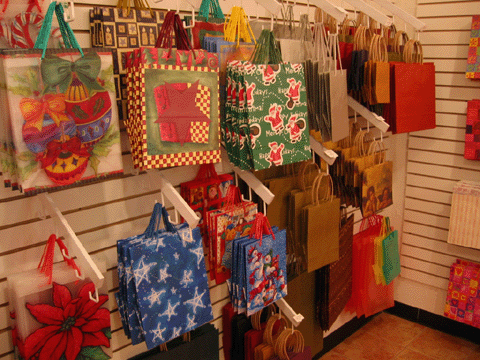
 The gift industry is quite substantial. This image is of 'Clinton Cards' - a company based in the United Kingdom that Specialize in the gift industry - selling cards, wrapping paper, gift cards and small inexpensive gifts. Giving a gift is heavily commercialized, with incentive to make the packaging of the gift a present within itself - to 'spruce' up the occasion.


- Examples of user bags crafts regarding gift bags. The positive (cheap, user influenced), The Negative, What I could improve on (Indie / Craft)
-  review of some gift bags
http://en.wikipedia.org/wiki/Bag

Year 2 - Processes and Materials - Research - Materials + Processes

Materials

Paper
For this module, there is an increased importance in the choice of material used for the final outcome. My choice of material would need to be an informed decision. As stated in my project proposal, I wished to use a material in which would be best adaptable for my skillset. As such, my first instinct was to look into flat material, and work on a 2d plane. Paper as a material seemed natural because of being able to use print as the connection between my work and my materials.

What is paper? 
'Paper was invented by the Chinese by 105 AD during the Han Dynasty and spread slowly to the west via Samarkand and Baghdad. Papermaking and manufacturing in Europe started in the Iberian Peninsula, today's Portugal and Spain and Sicily in the 10th century by the Muslims living there at the time, and slowly spread to Italy and South France reaching Germany by 1400. In medieval Europe, the hitherto handcraft of papermaking was mechanized by the use of waterpower, the first water papermill in the Iberian Pensinsula having been built in the Portuguese city of Leiria in 1411, and other processes.[1][2] The rapid expansion of European paper production was truly enhanced by the invention of the printing press and the beginning of the Printing Revolution in the 15th century.[3]
The word "paper" is etymologically derived from papyros, Ancient Greek for the Cyperus papyrus plant. Papyrus is a thick, paper-like material produced from the pith of the Cyperus papyrus plant which was used in ancient Egypt and other Mediterranean cultures for writing long before the development of paper in China.[4] Papyrus however is a "lamination of natural plants, while paper is manufactured from fibres whose properties have been changed by maceration or disintegration.[5]' - Wikipedia entry on 'history of paper'

 Paper is 'cellulose fibers' that is made into pulpwood. For recycled paper, the ink is removed from the material before it is remade back into pulpwood. There are many different results of pulping depending on whether the paper is recycled or not. The finish of the paper determines the application of the paper, and that is through it's coating (or lack of coating).


What is the importance of coating?
As the name suggests, coated paper has a coating, usually of china clay, which gives it a smooth finish. Coated papers are available in a gloss, silk (sometimes called satin) or matt finish and are used for projects requiring a fine finish, which is why coated paper is sometimes referred to as 'art' paper. 
Uncoated paper doesn't have a coating and is therefore not as smooth as coated paper. You will use uncoated paper in your laser printer and photocopier.  - information from http://www.tomtheprinter.co.uk/2007/01/choosing-paper-for-your-print-project.html
  
How is paper made?
The fibers that make up paper comes from wood. There are two different types of wood - 'hardwood' and softwood'.
Hardwood trees such as oaks and maples have wood with very short fibers. Paper made from these species is weaker than that made from softwoods, but its surface is smoother, and therefore better to write and print on.
Softwood trees such as pine and spruce have wood with long fibers, and paper made from this type of wood is much stronger. This paper is ideal for making products like shipping containers that require superior strength. But the finish is rougher, and that's not as good for writing, printing and many other uses.
Happily, we can blend fiber from hardwoods and softwoods into a single paper, getting just the combination of strength, whiteness, writing surface and other characteristics that we want. - information taken from http://www.tappi.org/paperu/all_about_paper/papermade.htm
There are many different types of paper designed for different applications; such as drawing and painting. In my particular case, the type of paper I researched was paper suitable for print. My work is entirely digital, with a few exceptions here or there. To understand more about my material, I needed to distinguish certain types of paper.

TypeDescriptionEnd-USE
Cast coated paperProvides the highest gloss surface of all coated papers and boards Labels, covers, cartons and cards
Calendered or glossy paperPaper that has gone through a glazing process – can be both coated and uncoated Colour printing

Machine finished paperPaper which has been finished on the papermaking machine and is smooth on both sidesBooklets and brochures

Lightweight
coated
 A thin, coated paper, which can be as light as 40 g/m2.

Magazines, brochures and catalogues
Matt finished paper


The relative roughness of the paper surface prevents light from being reflected. Can be both coated and uncoated

It is used in all kinds of high quality print work and is suitable for colour printing

Machine coated


Paper that has the coating applied whilst it is still on the paper machine

All types of coloured print


Silk or silk matt finished papersLike matt finished coated paper the surface is smooth but without reflections, which means that it combines high readability with high image qualityProduct Booklets and Brochures

Brightness

  • Printing paper comes in different brightness levels measured from 1 to 100. The highest numbers, reflecting the most light, make reading difficult but are best for photo printing.

Weight

  • Papers come in different thicknesses, also known as its weight. Common printing paper has a weight of 20 lbs. while the heaviest cover stock has a weight up to 120 lbs.

Opacity

  • Paper also comes in different levels of opacity, which simply means how much items printed on it will show through to the other side. Opacity is measured from 0, meaning transparent, to 100, meaning completely opaque.
information from http://www.ehow.com/facts_4947675_different-types-printing-paper.html

How paper is used
Paper can be produced with a wide variety of properties, depending on its intended use.[9]
How sustainable is paper?
Paper is, on a fundamental, sustainable; it is a renewable source.With careful deliberation, if trees are replanted after they are cut down, then they will be replaced. Of course, the rate of replenishment is dependent on the ratio of trees being cut to trees being grown; trees take a while to grow, meaning that it would take years for there to be an equal input into the environment. However, the rate of which paper is produced leads to it having impacts on the environment. 

As a printing substrate, paper offers a wide array of advantages: it is a sustainable material ideal for printing; it is light-weight, resistant and versatile; and it is constantly being developed with new applications in mind.

The sustainability of paper stems from its being a natural, renewable, recyclable product manufactured with clean, efficient and responsible technologies that contributes to improving the quality of life.

The life cycle of paper is integrated and sustainable.  Trees produce wood by absorbing carbon dioxide, which remains stored inside paper.  Recovery and recycling of used paper products extends the useful life of the cellulose fibres obtained from wood, thereby optimizing the advantages of this natural resource. 

Moreover, used paper that does not enter the recycling circuit (for not being a suitable raw material) can be used as fuel, as can biomass and the wastes resulting from the manufacturing process.  The result is the completion and balancing of the sustainable cycle of paper, which begins with a renewable, natural source of raw material. - Information from http://www.torraspapel.com/en-us/sostenibilidad/lasostenibilidaddelpapel/pages/default.aspx
A counter-argument.
Paper products are the single biggest component of solid waste disposal sites, and as such represent a considerable environmental and social problem.  Paper recycling can reduce the amount of paper to find its way to waste disposal.  Recycling reduces the environmental and social costs of original paper production, but is not without its own costs such as increased use of fossil fuels in transporting the material for recycling, and costs in the reprocessing itself. 
The environmental and social costs of tree-based paper production will force us to look more to other sources.  It is sobering to think that two out of every five trees are cut for pulp.  The current pulp paper production releases large amounts of dangerous pollutants, such as chlorine, dioxin and furans into the air and water. - Information from http://www.lusabooks.com/
Overall, I would argue that the benefits of paper outweigh the negative impact.

Ink / Dye


For printing, there are two different types of ink used; pigment based and dye based. I have included this information for my research to highlight the importance of knowing what ink to use in order for the best result, that is cost-effective, for my product.
  • Pigment
  • water fast on most paper media (dye based inks start to run when wetted if not printed on specially coated paper)
  • fast drying (up to 100 times faster compared to dye based inks)
  • non fading colors
  • long life cycle
  • low bleeding in the edges of the printed color
  • Dye
  • high brilliance and contrast
  • wide color gamut (i.e. the range of colors that can be produced)
  • less expensive

Information from  http://www.inkguides.com/printers-ink.asp

Can Ink be Sustainable? 
Normal ink isn't very sustainable, due to the substances within it. However, the type of ink you use can be sustainable, or more sustainable than the cheaper more mass produced ink.
Inks traditionally contained petroleum. Environmentally friendly inks contain vegetable oil instead and reduce the levels of so-called Volatile Organic Compounds (VOCs) that have traditionally been a by-product of the printing process. Eco-friendly inks also lead to a large reduction in water usage for press washups that can be in the region of a 60% saving. Vegetable-based inks do not compromise quality; indeed, they have better drying characteristics than traditional inks. - Information from http://www.steffprint.co.uk/eco_friendly_printers.html#


Processes


I researched into the printing process to understand the basics of how it would come into fruition if my work was to be mass produced. There are different ways of printings. These processes are: Offset Lithography, Digital Printing, Letterpress, Electrostatic, and Thermography. The most used practice is Offset Lithography.


The most common printing method in the industry, most printers use offset lithography to save on ink and limit set up time. Hence, you are able to avail of a more affordable and cost effective print job for your color printing requirements. What printers usually do is to offset the ink (thus, the name) from metal plates to a rubber cylinder and then transfer it onto the paper stock.

 It is probably the most popular printing method since its introduction. Digital printing is very effective since it reduces the time to complete the printing process. It doesn't need films and plates any more. What it does is to transfer the digital file directly to the printing press with the help of a computer. It’s relatively fast that customers often rely on digital printing to meet deadlines and schedules.

 Created by Gutenberg, the Letterpress is considered as one of the first and original printing methods of all time. The letterpress gave birth to the concept of relief printing, where the image being printed is raised from the surface. However, the method is slowly going obsolete with the new and much faster methods being introduced in the market today.


Electrostatic Printing. Similar to photocopying, this method lets the color attach to a drum and is blended with the paper with the application of heat. It is similar to digital printing as it also provides cost effective production of short print runs.


This method produces raised image that you see mostly in stationeries. What the printer does is to use a special powder or dust that easily sticks to wet ink. Then they apply heat to blend the ink and the powder to form the raised image.


Printing is available to everybody, with specialized companies set up in taking orders that are not necessarily made in bulk. Anybody can have what they want printed, opening up the market and making things heavily competitive. On the upside, it is easier to have your 'foot in the door', especially if you are self-employed and wish to make industrial contacts without having to be part of a large company. On the downside, it means that you have to work harder in order to get your work recognized; skill and self-promotion is what sets apart those whom are successful and unsuccessful.

Here are some websites in which specialize in printing;
http://www.lulu.com/ - A web-based company that specialize in books. They offer services to print books as well as publishing services. They are one of the leading companies in this genre.

Printing in general, a small sample
http://www.stressfreeprint.co.uk/  


YEAR 2 - Processes and materials - Research Bibliography

Following my project proposal, I have sorted my research into different categories; research about materials, research on bags, research on branding and character design, and a case study on a designer that inspires me through their illustration and product placement.

My research on material was to do with how I would be able to create my product in most sustainably economic way. Also, of how this could be done to the highest quality in synergy with my specialism. I mainly looked into the fundamentals, such as paper, printing, and the digital medium as a whole.

My research into bags was to get an idea of the bag as a concept, and how different bags are used for different purposes. I also look into gift bags as a whole, and their utility and function, since this is the direction that I wish to pursue.

My research into character design was exploring the different avenues I could take in regard to the design of the gift bag. I look at gift bags which have a target audience of children, and I look at popular brands and how their character design and ethos has been adapted into this medium.

And finally, to tie up my research, I decided to do a case study on an artist whom has expanded into product design from illustrations, and who is extremely commercially successful.

 BIBILOGRAPHY.


O T H E R   M A T E R I A L S
P A P E R
C O M M E R I C A L   B A G S
B R A N D S
I N D I E / C R A F T  B A G S

C H A R A C T E R   D E S I G N

Wednesday, 15 June 2011

YEAR 1 - Professional and Contextual analysis - Professional Bodies


The association of illustrators is a non governmental body with the purpose of protecting illustrators and their works. In particular, if an illustrator is worried about the usage of orphan work, and other copyrights. The group is made up of freelance illustrators, agents, clients looking for illustrative works, students and lecturers. There is no assessment required to join the association. The services they offer include portfolio advice, law and business advice, client directories, discounts on art related projects, a dedicated online portfolio site, and support for students and newly qualified illustrators. The body identifies itself and it's services by being a member of the following associations; Pro-Action Campaign and Liaison Group, the British Copyright Council, the Creators Rights Alliance and the European Illustrators Forum. The benefit of membership to the AOI is that there is a possibility of becoming a featured artist, which is represented monthly, and thus gaining creditability from the spotlight. As well as supporting long-term members, there is also a section dedicated in showcasing new subscribed members, giving vital connections to inspiring illustrators.


The Chartered Society of Designers describes itself as the 'professional body for designers and the authority on professional design practice' and holds it's headquarters in London. The CSD is international, with members spanning '33 countries' involved. The group exists to promote and encourage 'sound' design principles, as well as add a form of regulation and control the practice of the design industry. It is a registered charity, and is not a trade body or an association. The CSD prides itself on the quality of it's establishment. As such, there is a professional requirement in order to join the society, in form of an assessment of your capabilities. Membership is co-ordinated through a tier-system, consisting of 'Student', 'Graduate', titles in the form of 'MCSD (Member of the Chartered Society of Designers) or FCSD (Fellow of the Chartered Society of Designers), and associate. The CSD is influential in the power it holds through these titles, thus seasoned designers are attracted to join the society.


Design Nation is an 'exempt' charity, originally called the Design Trust. It is a British establishment, with the aim of 'promoting the excellence of British design'. The main functions of charity is to help designers with business propositions after they have qualified and to manage the 'Eureka' Project, which creates communication between designers, retailers, and manufacturers. The Design Nation is it's own identity, while the activities provided under their previous name (The Design Trust) is funded and carried out by the Sir John Cass Department of Art, Media and Design of London Metropolitan University. In order to join the Design Nation, there is a selection process based on the quality of your work, and if it is exceptional design, then the charity might consider helping with the production of your design. The Design Nation website features british design available (based on it's membership) for commission. The charity categorizes design by five types; Furniture, Ceramics & Glass, Interior/exterior design & products, Silver, gold, metalwork & jewellery, and Textiles & fashion accessories.
By being a part of the design nation, budding designers can use it as a platform to showcase their designs as well as gaining a secure connection to potential clientele. Due to the selection process, membership also represents an assurance that your work is of a standard quality, and thus you gain more confidence in your commissions. The design nation prides itself on it's contacts, boasting a selection panel including Jasper Morrison, Jeremy Myerson, Jane Priestman, Robin Levien, Frances Sorrell (Sorrell Foundation), Paul Dyson (Goldsmiths Company), Sheridan Coakley.


D&AD stands for Design and Art Direction, and is an educational based charity, with the aim to promote quality design and advertisement. Their education department has several programs designed to support and encourage 'creative professionals' within their career. There is a dedicated student programme for helping students break into the industry, including student edition awards. With D&AD. their support continues beyond graduating with their 'Continuing Professional Development' program, which sets to challenge and inspire creatives. To continue with the educational theme of D&AD, there is an annual program of lectures and professional events which run both nationally and internationally. D&AD describes itself as an organisation wishing to 'push the boundaries' of the creative industry. Anybody can apply for fee-based membership, however to be distinguished within the body, there is a tier of membership for those whom have high quality design recognized by the organization and awarded.

YEAR 1 - Professional and Contextual analysis - 3/5:Hayao Miyazaki


Tuesday, 29 March 2011

YEAR 1 - Professional and Contextual analysis - 1/5: Quentin Blake


Quentin Blake was born in 1932, and has enjoyed a career of illustration spanning, arguably, over 70 years. When talking about his first ventures into art, according to Blake, 'there was nothing to suggest that I could draw - my parent's certainly couldn't'. A fond memory of his involves a spectator's viewpoint upon a drawing of his when he was a young child, commenting that 'he draws a lot, but he won't speak!'
"I don't wait for inspiration. I'm not, in fact, quite sure what inspiration is, but I'm sure that if it is going to turn up, my having started work is the precondition of its arrival."
Quentin Blake (Words and Pictures)

Tuesday, 25 January 2011

YEAR 1 - Computer Applications - 5 Influencial Designers preview!

Visuals done by
For me, design goes from product design to fictionary design (books are designed with a purpose, art is designed (although you could argue 'avant guarde' tries to evade this'). The people whom I have chosen may not be seen as 'true designers' however their work has impacted on their targeted fanbase, which to me is part of design. The designers are beyond the break!